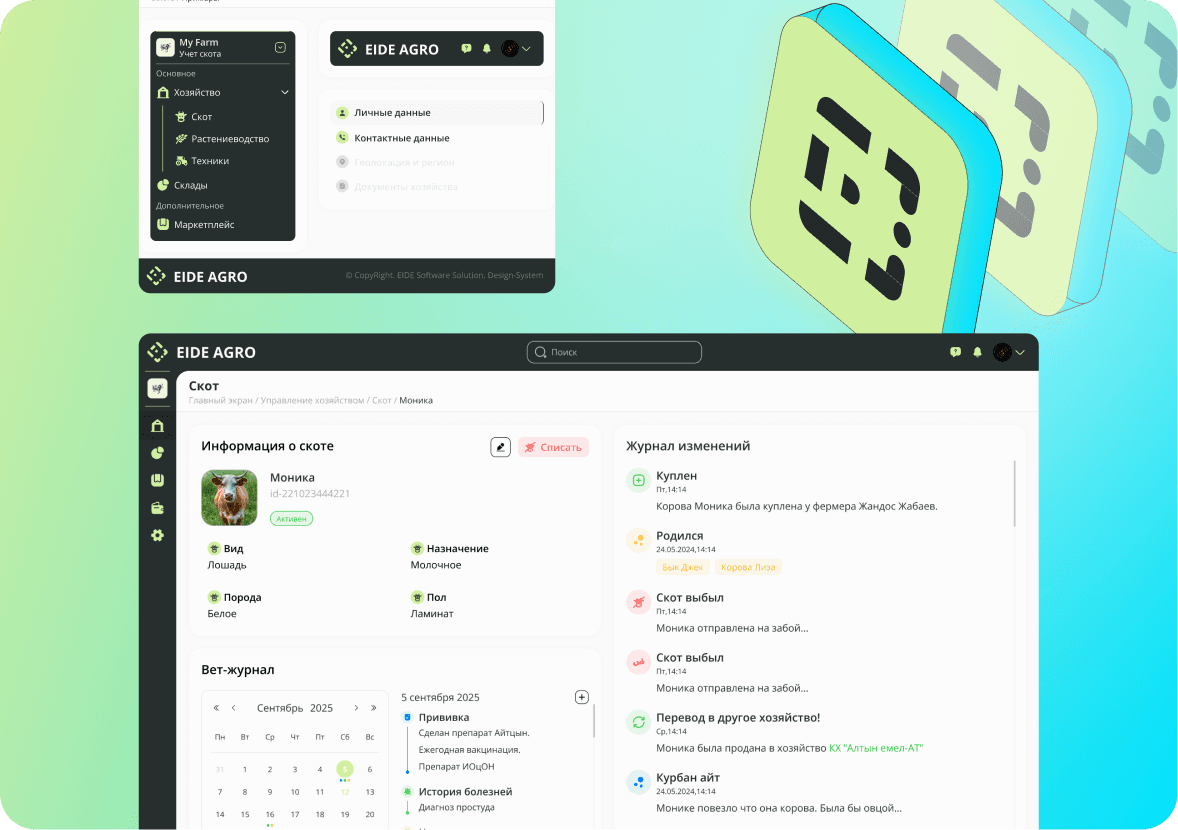
One SuperApp instead of 5+ scattered services for farmers
A product from zero to MVP: from market analysis and CJM to interfaces and a design system
5 → 1
services combined in one SuperApp
0 → MVP
in 3 months
1
designer for the whole product
Overview
Farms and procurement companies operate under a lot of uncertainty. The market has no single system that brings all of a farmer's processes onto one platform. Most work is done by hand: in Excel, paper logs, messengers and verbal agreements. This creates messy data, makes procurement less transparent and complicates managing fields, storage and logistics.
Goals
Build one platform that standardizes farmers' processes and brings analytics, procurement, farm management and communication into a single SuperApp, with transparency at every stage, from planning the season to selling the harvest.

My role
The key task from the CPO was to make farmers' and procurement companies' first experience with the SuperApp simple and clear. I was involved in the platform from the very beginning and shaped the product approach together with the CPO.
Product vision
Tie every feature and process into one system.
B2B process analysis
Understand the real tasks, pain points and work scenarios.
CJM
Cut unnecessary steps and speed up decisions.
Information architecture
Simplify navigation and make complex data accessible.
Design system
Keep the product consistent and scalable.
Prototyping and testing
Test hypotheses and improve the experience at every stage.
Competitive analysis
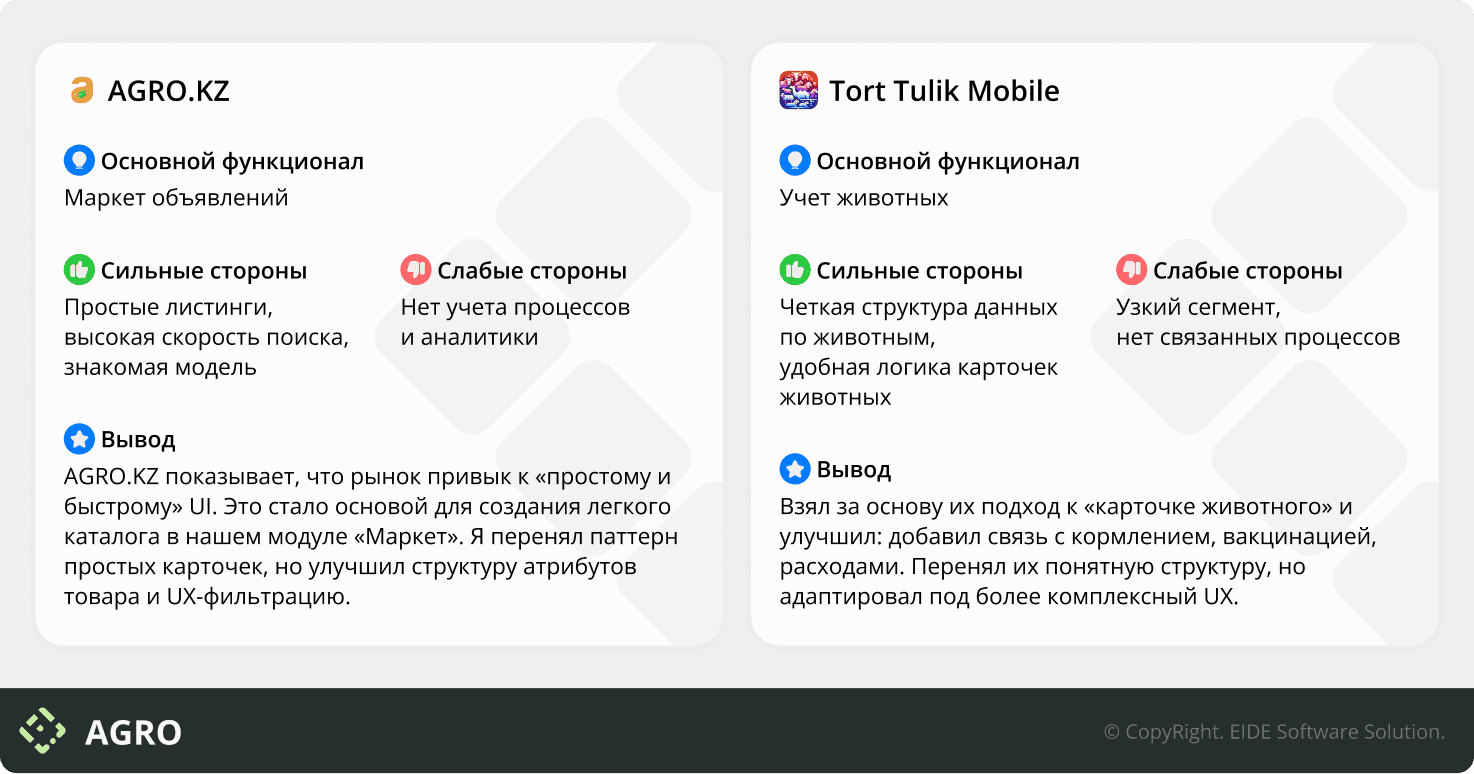
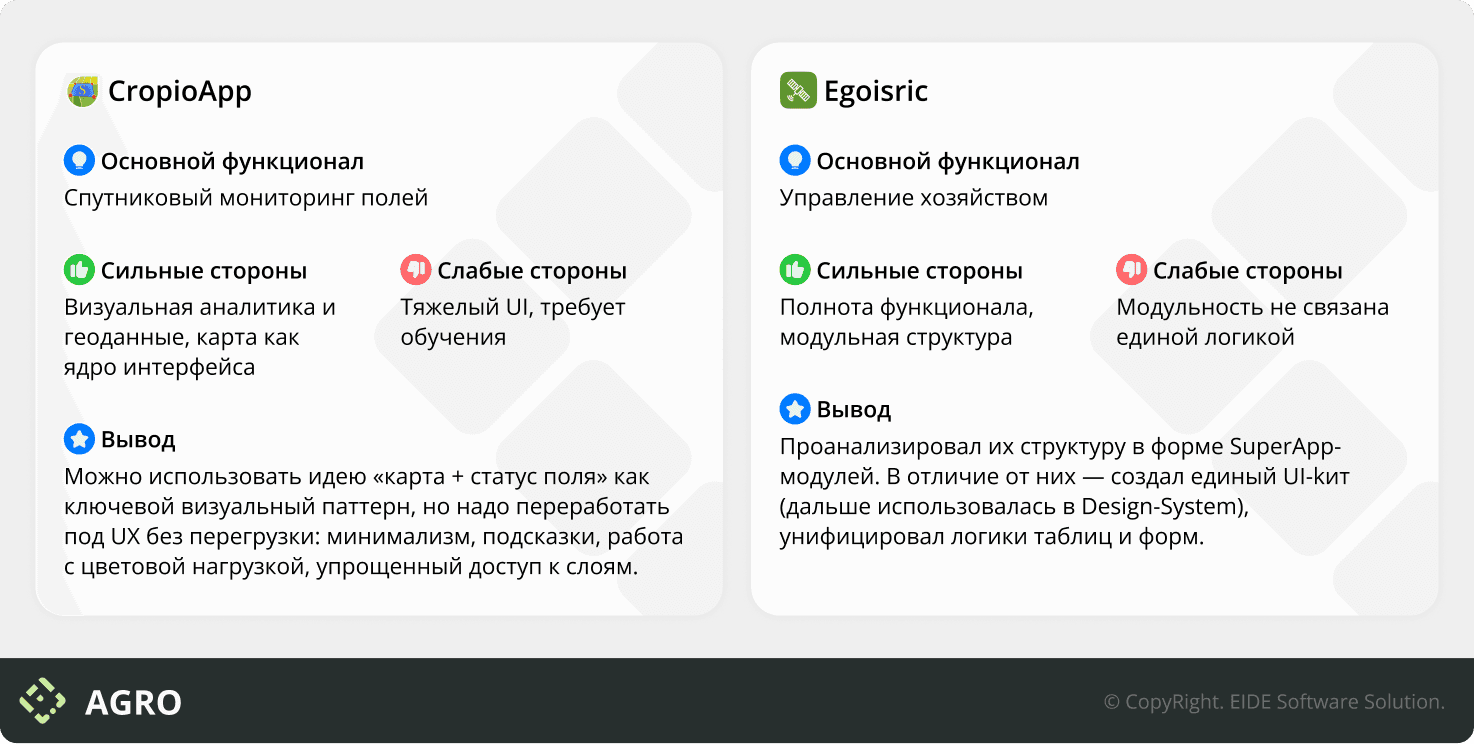
The agritech market in Kazakhstan is fragmented, and global products confirm it: each service covers one area of a farmer's work. There is no complete SuperApp that brings together fields, livestock, machinery, storage and sales.
Takeaway
Each service does one thing well, but none of them solves the problem as a whole. My job was to take the best UX patterns from different niches and combine them into one ecosystem built around the B2B processes of farmers and buyers.
Research and CJM
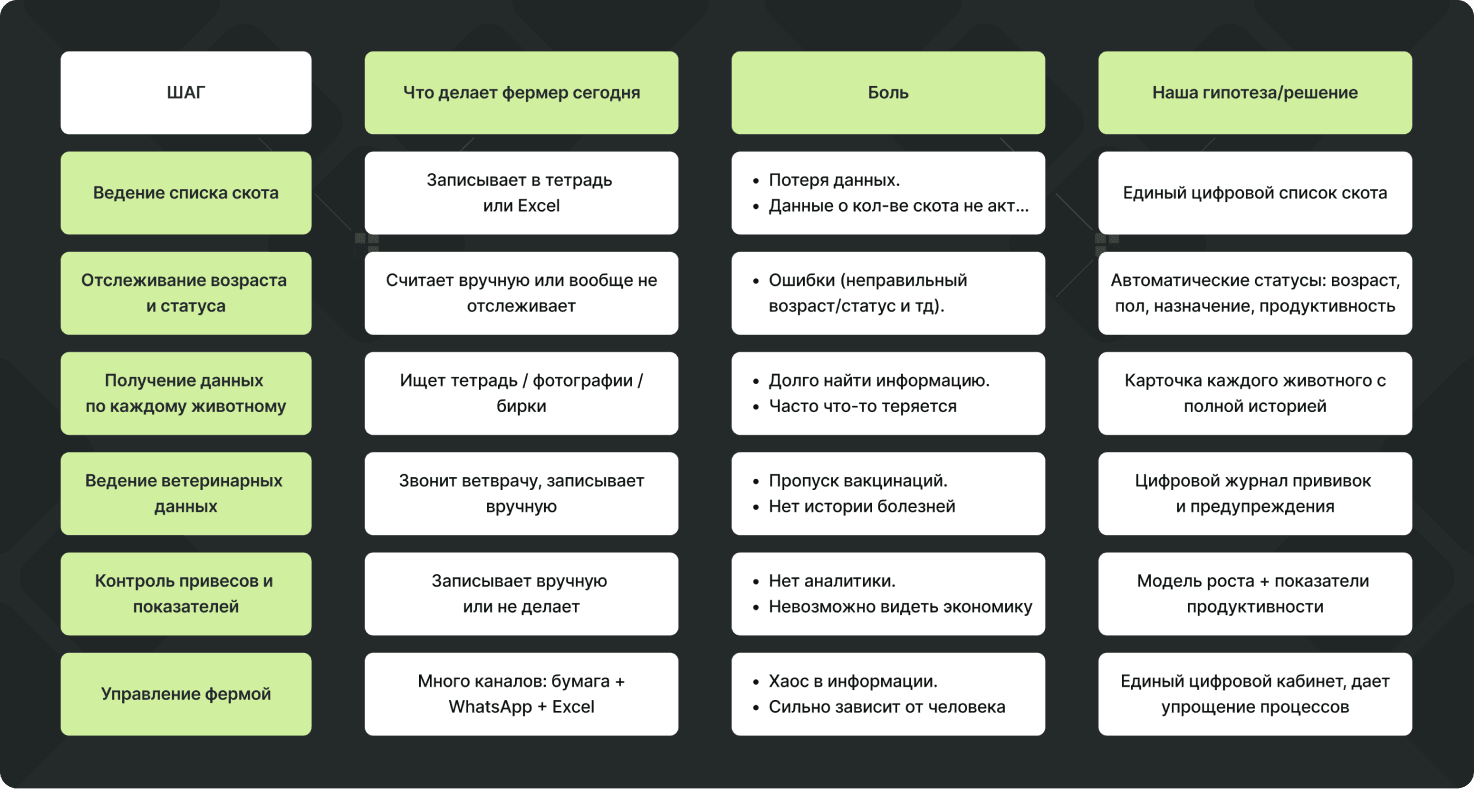
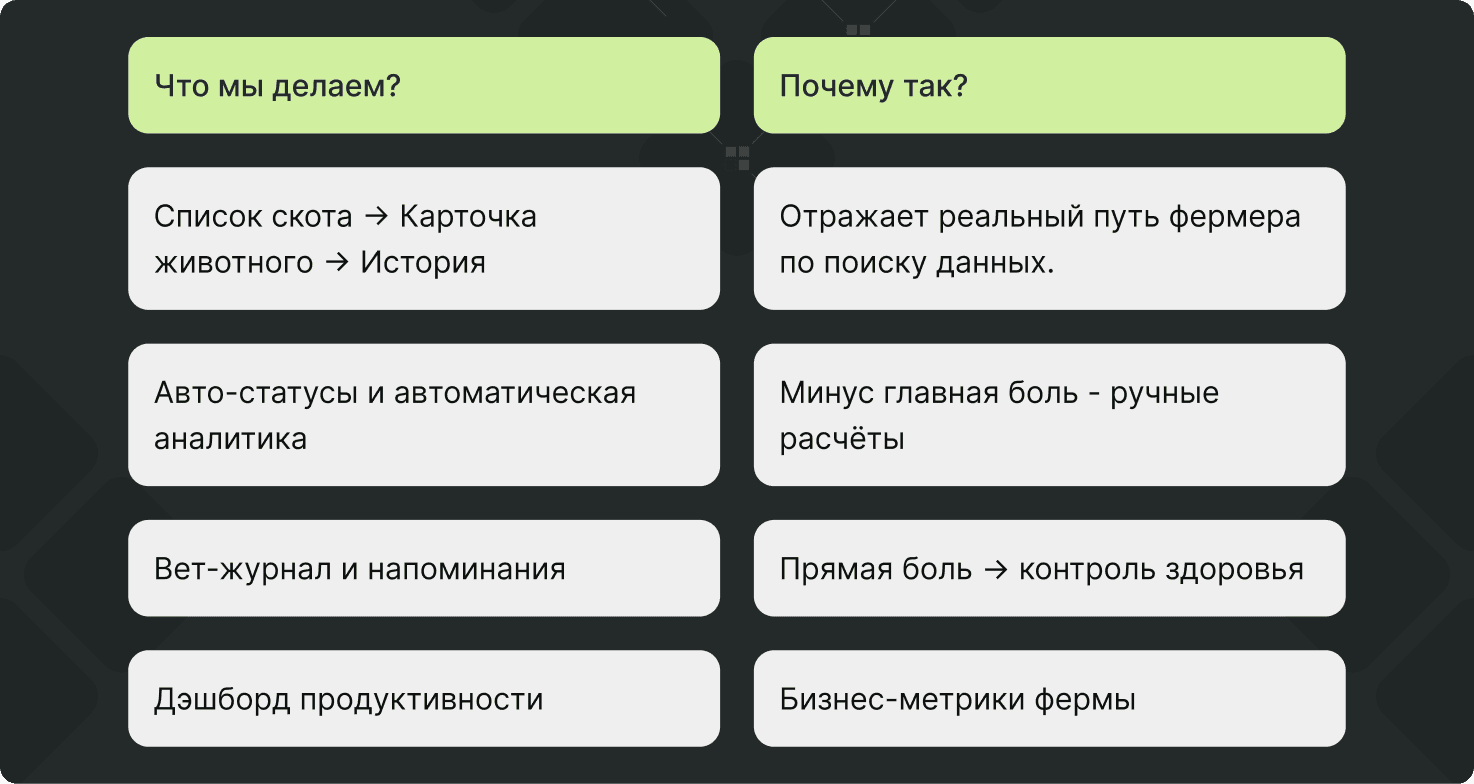
The competitive analysis gave us our first hypotheses. To test them, the PM and I ran a survey of farmers and agronomists. Below I show the work on one module: Livestock.
Problems
Manual records, lost data, no analytics.
The AGRO solution
Everything digital: accuracy, time saved, all data in one place.
User flow
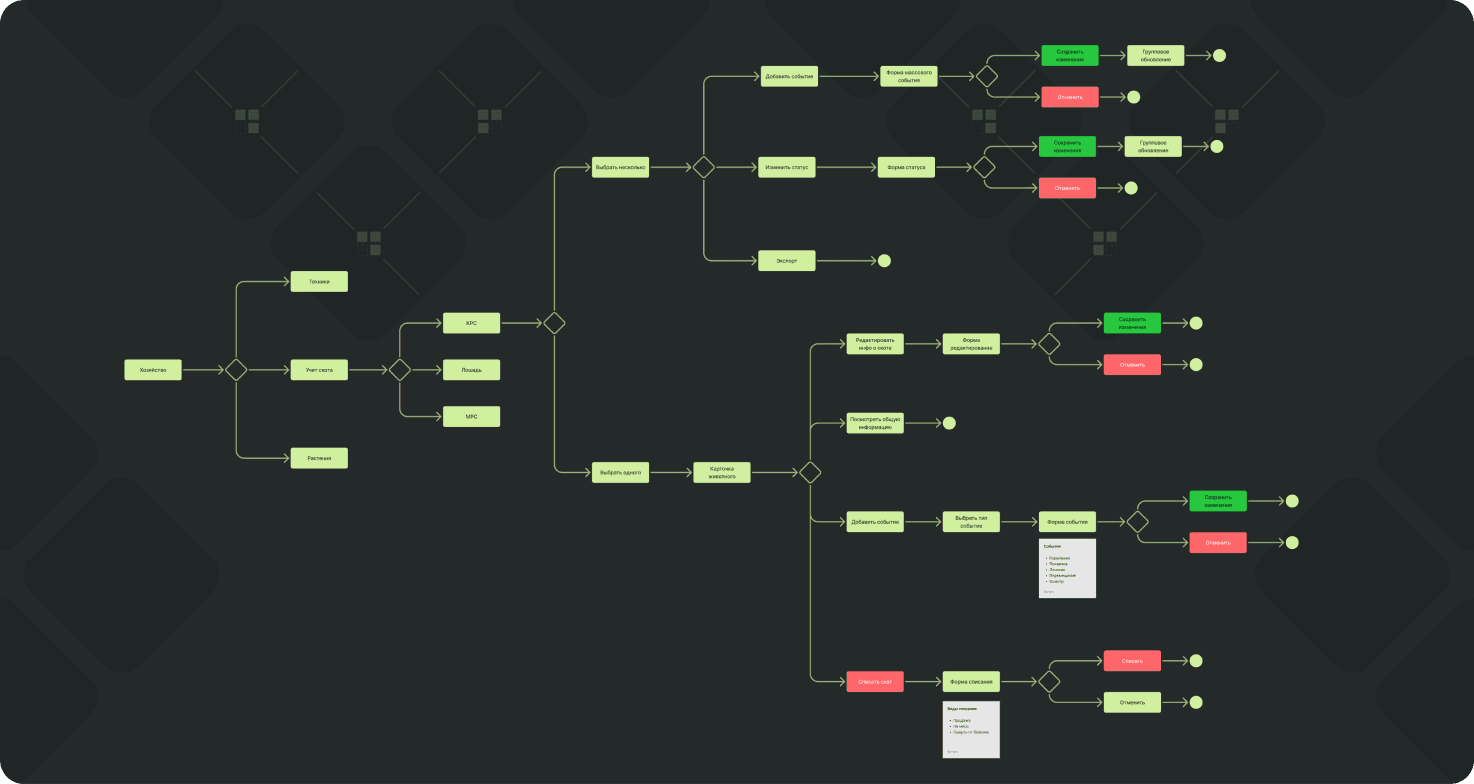
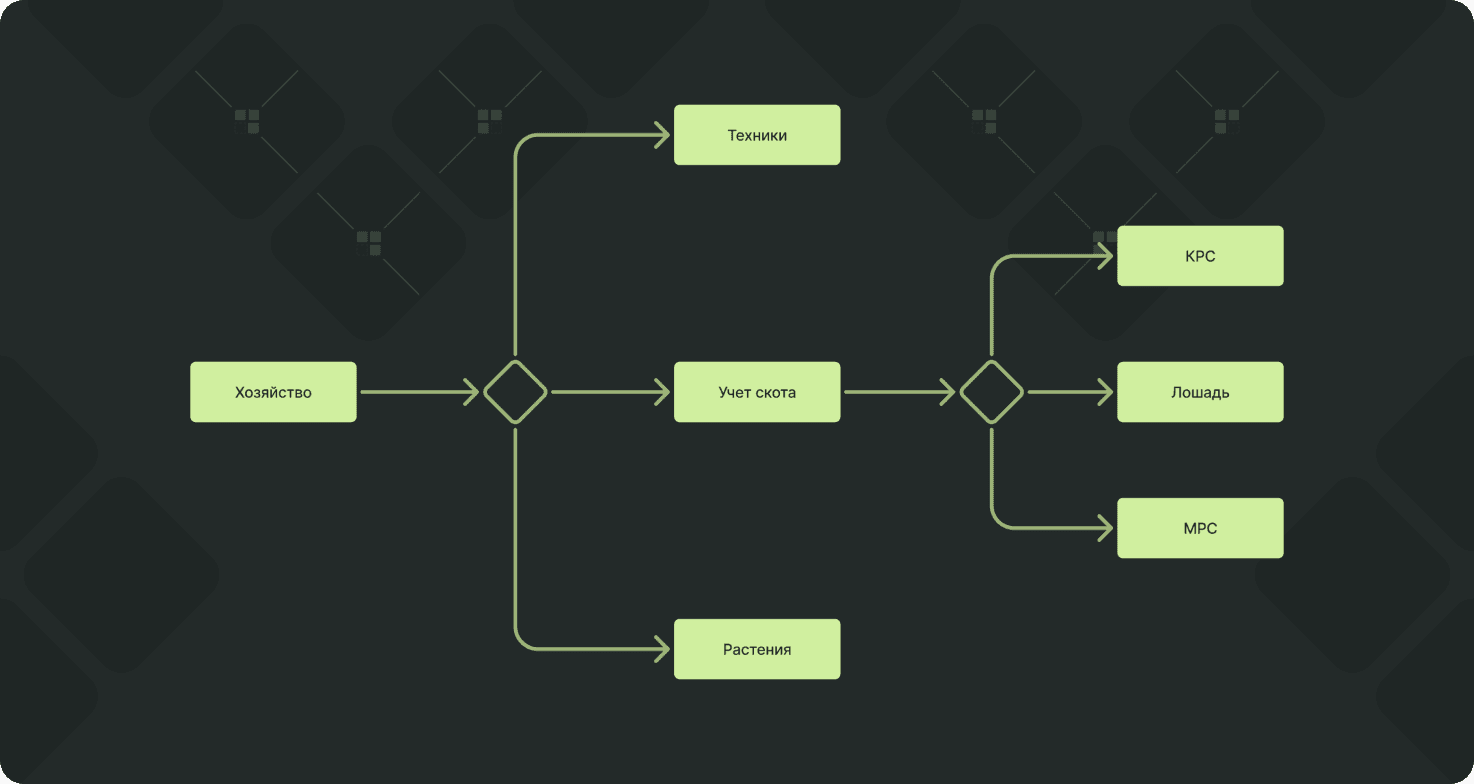
Key decisions
Why the interface works the way it does
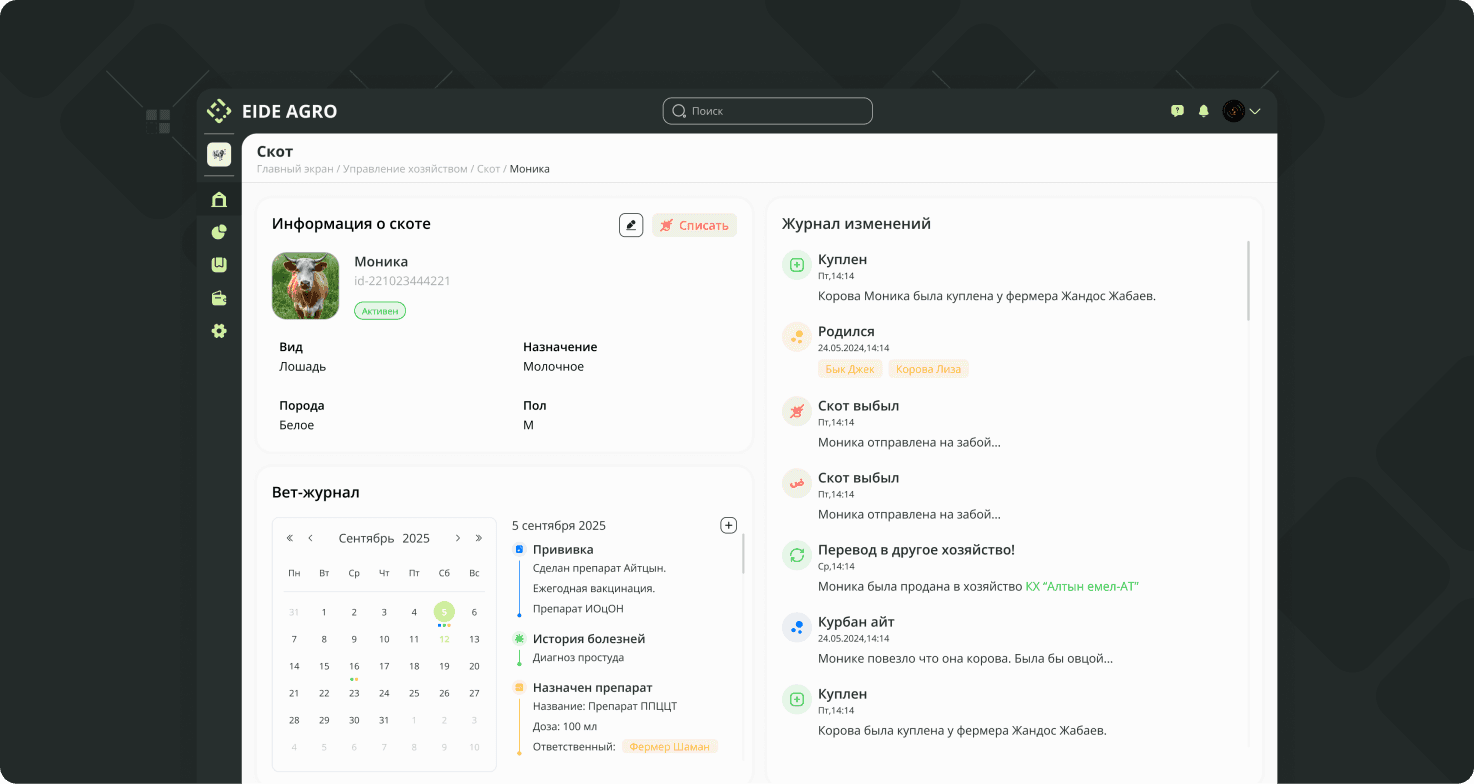
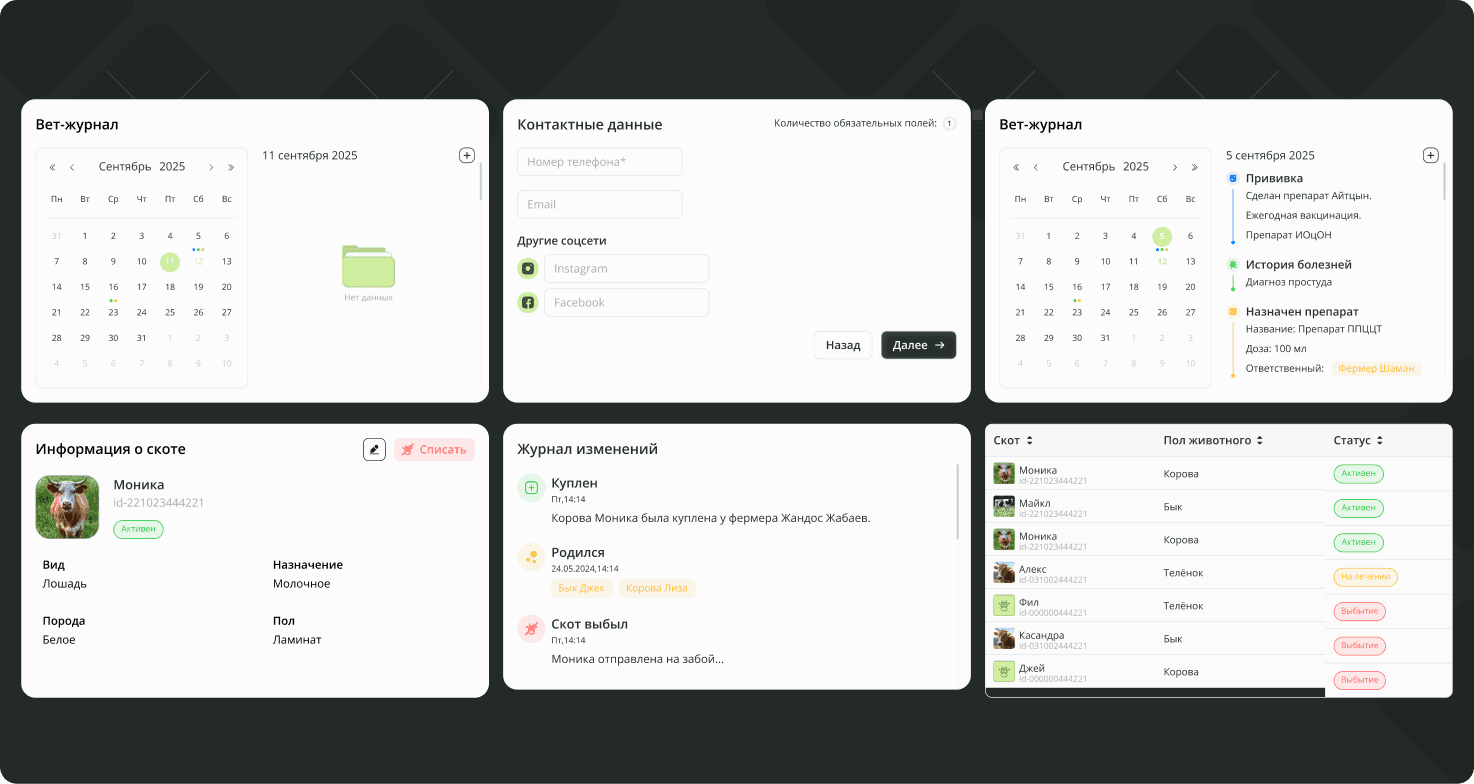
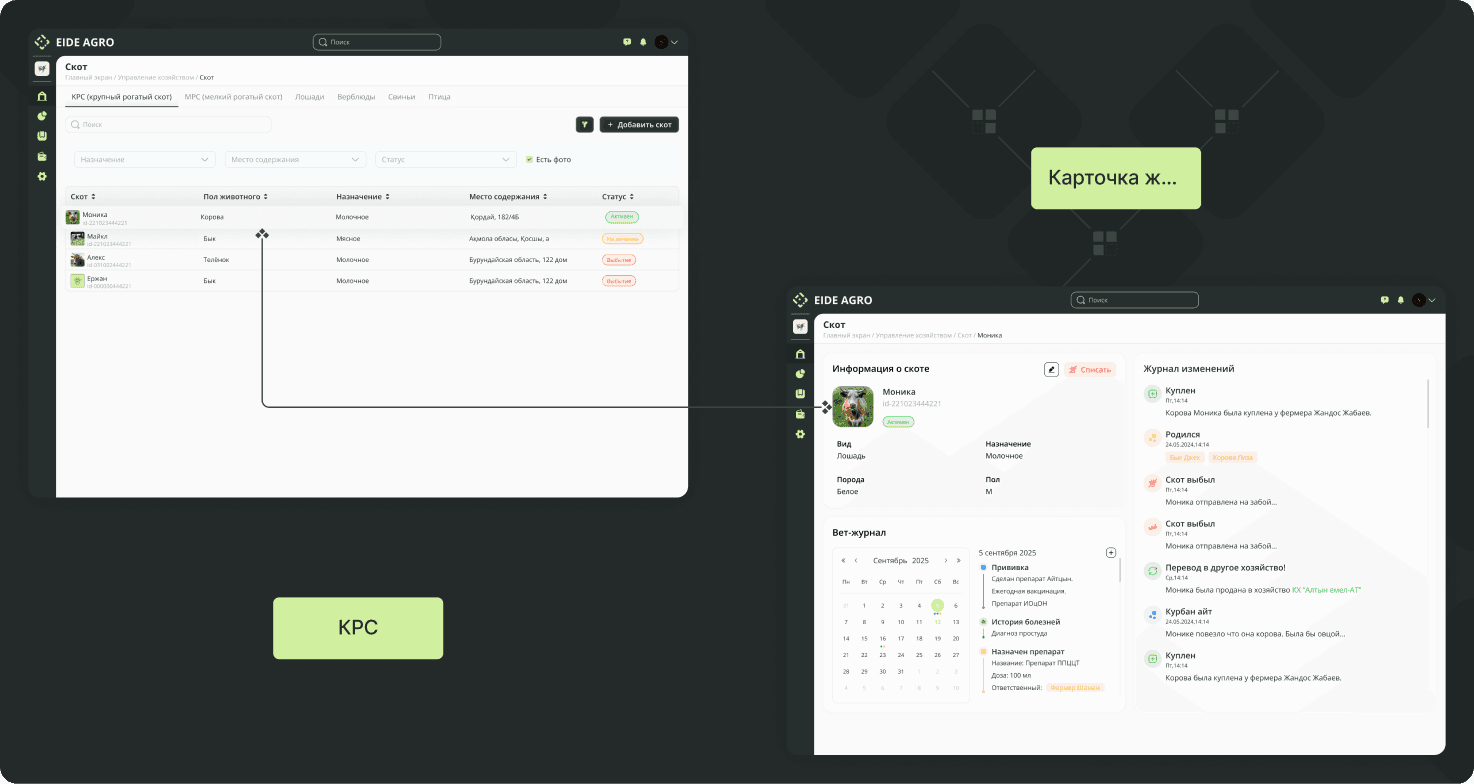
Animal profile and change log
Problem
Each animal's history lived in a notebook or wasn't kept at all.Bought, born, sold, moved to another farm: it was all kept in the farmer's head and got lost.
Decision
An animal profile with a change log: purchase, birth, removal and transfer are recorded with a date and stay in the history.
Why?
The first step is simply to start collecting data. A chronological log is the simplest format and is familiar to anyone who used to keep records in a notebook.
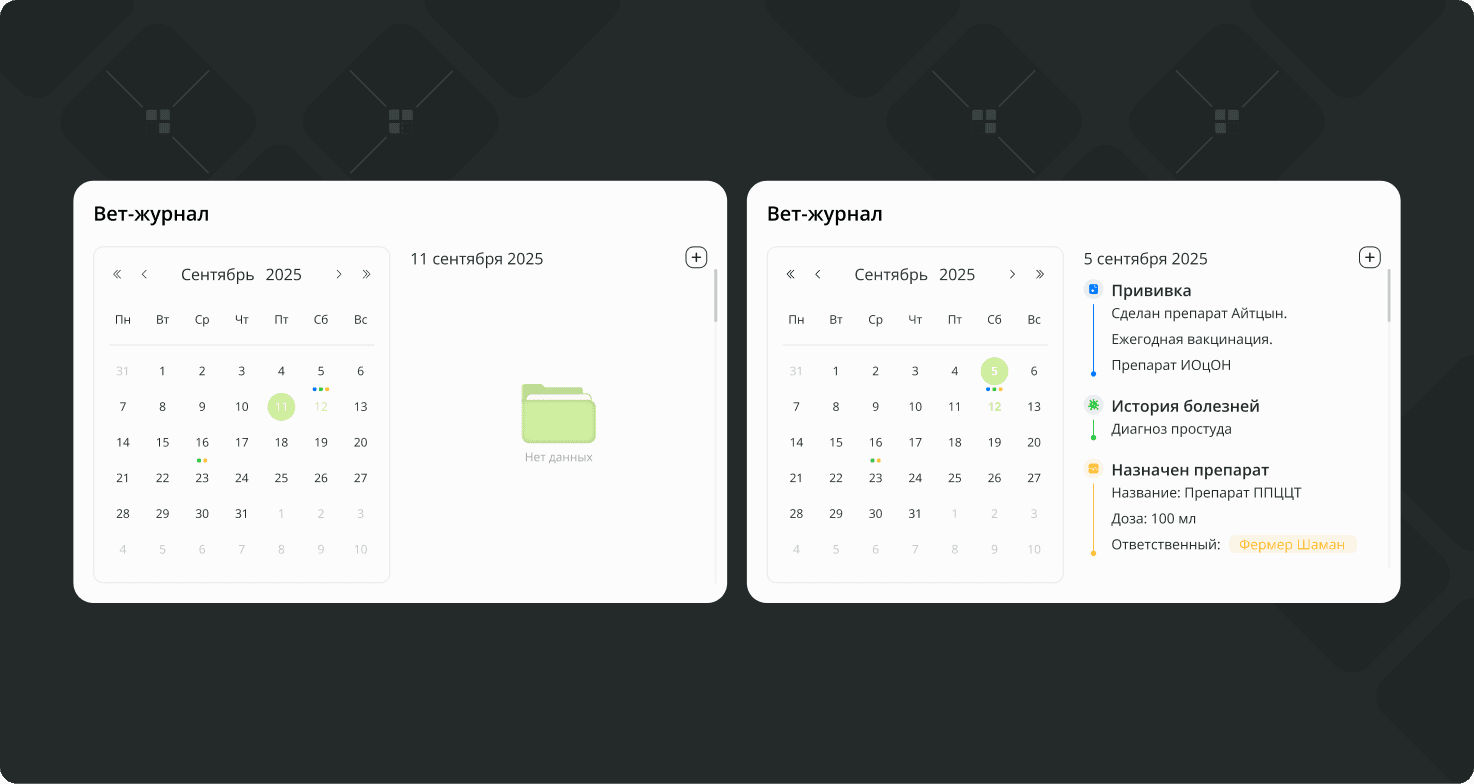
Vet log with a calendar
Problem
Farmers have a vaccination plan, but it isn't at hand:it's hard to remember when the next vaccination is due and to prepare for it.
Options
Stick to push notifications about vaccinations. A calendar inside each profile was rejected at first.
Decision
A calendar in the animal profile: past and upcoming vaccinations and the medical history in one place. The system calculates and records the next vaccination date itself.
Why?
The hypothesis: farmers will open a specific animal's profile and want to see its whole veterinary history, past and future. A push notification reminds about an event but doesn't show this context.
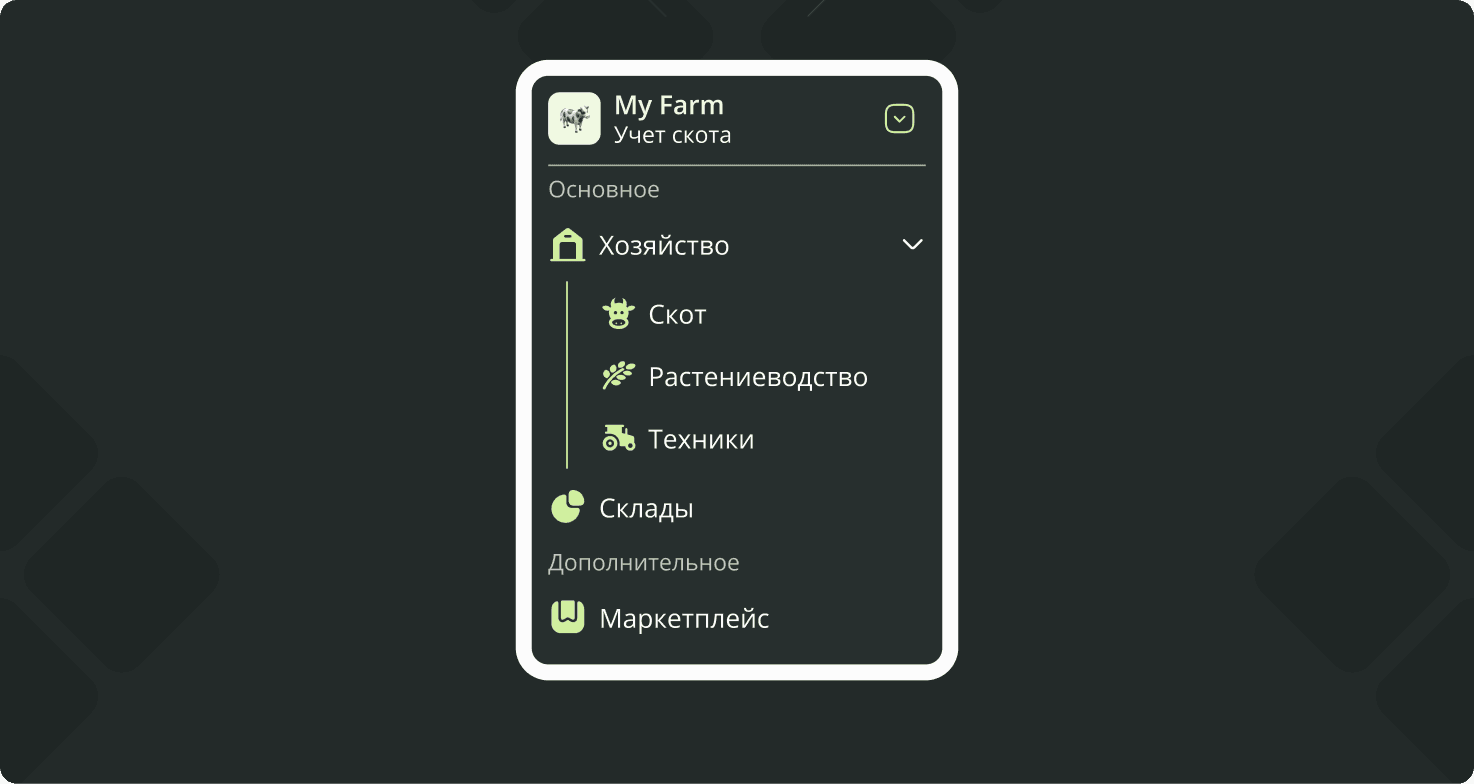
SuperApp navigation
Problem
Competitors focus on one module: some only on livestock, others only on machinery. Nobody offers a single place to run the whole farm.
Decision
A sidebar that splits the farm into modules (livestock, crops, machinery), with warehouses and the marketplace placed separately.
Why?
A single place to run the farm was the product's main goal, set by the CPO. Navigation had to fit 5+ services into one interface.
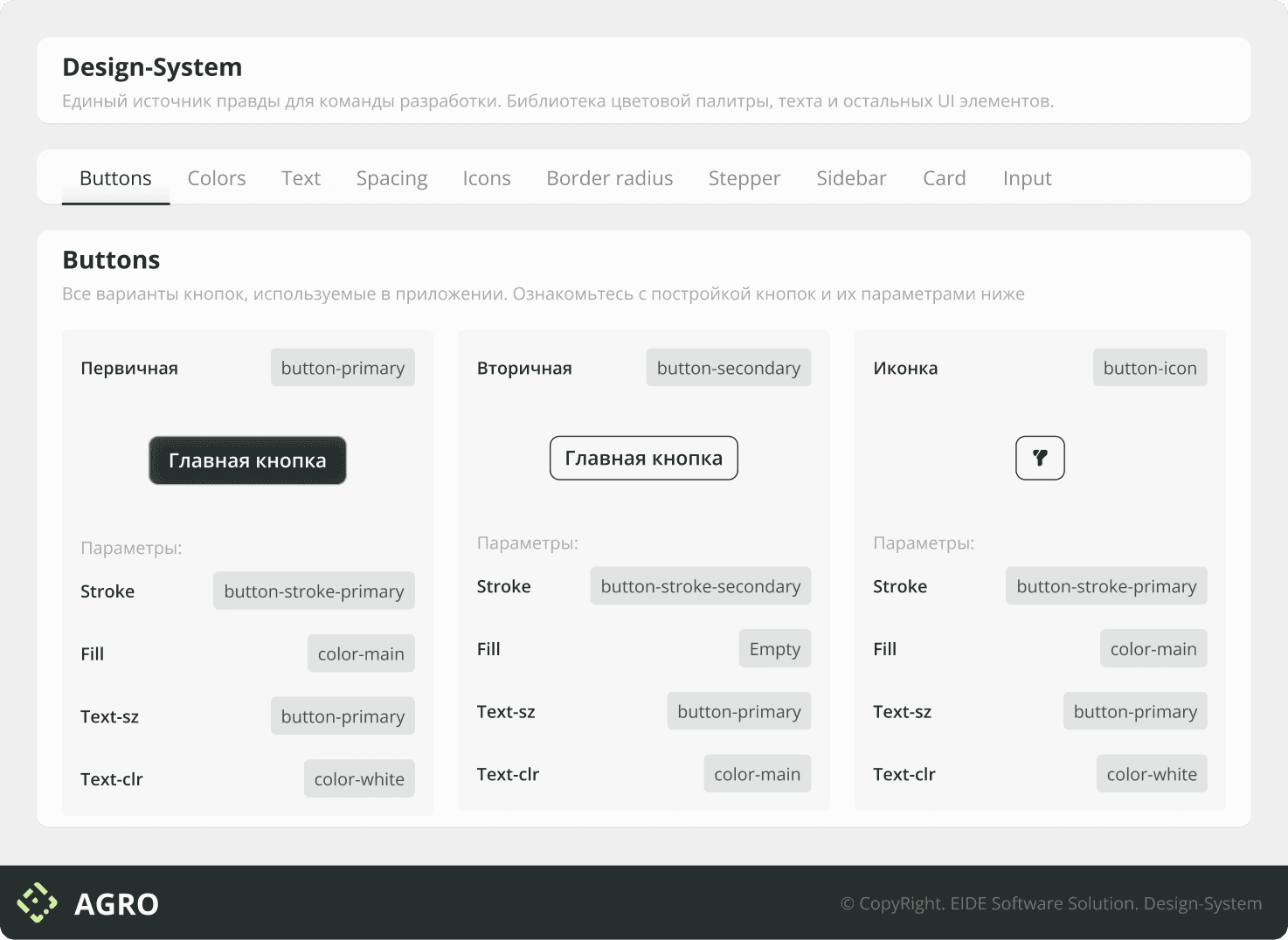
Design system
The design system became the single source of truth for the development team: visual consistency, faster development and easy scaling. Tokens and reusable components let it support theming.
Color palette
Built around the context of an agricultural product.
Typography
An expressive typeface for headings and a neutral one for content.
Grid and spacing
A modular grid for desktop scenarios.
Components
Every core interface element is a reusable component.
Icons
Icons and UI patterns were designed as part of the same system.
Documentation
A single reference on how to use the design system.
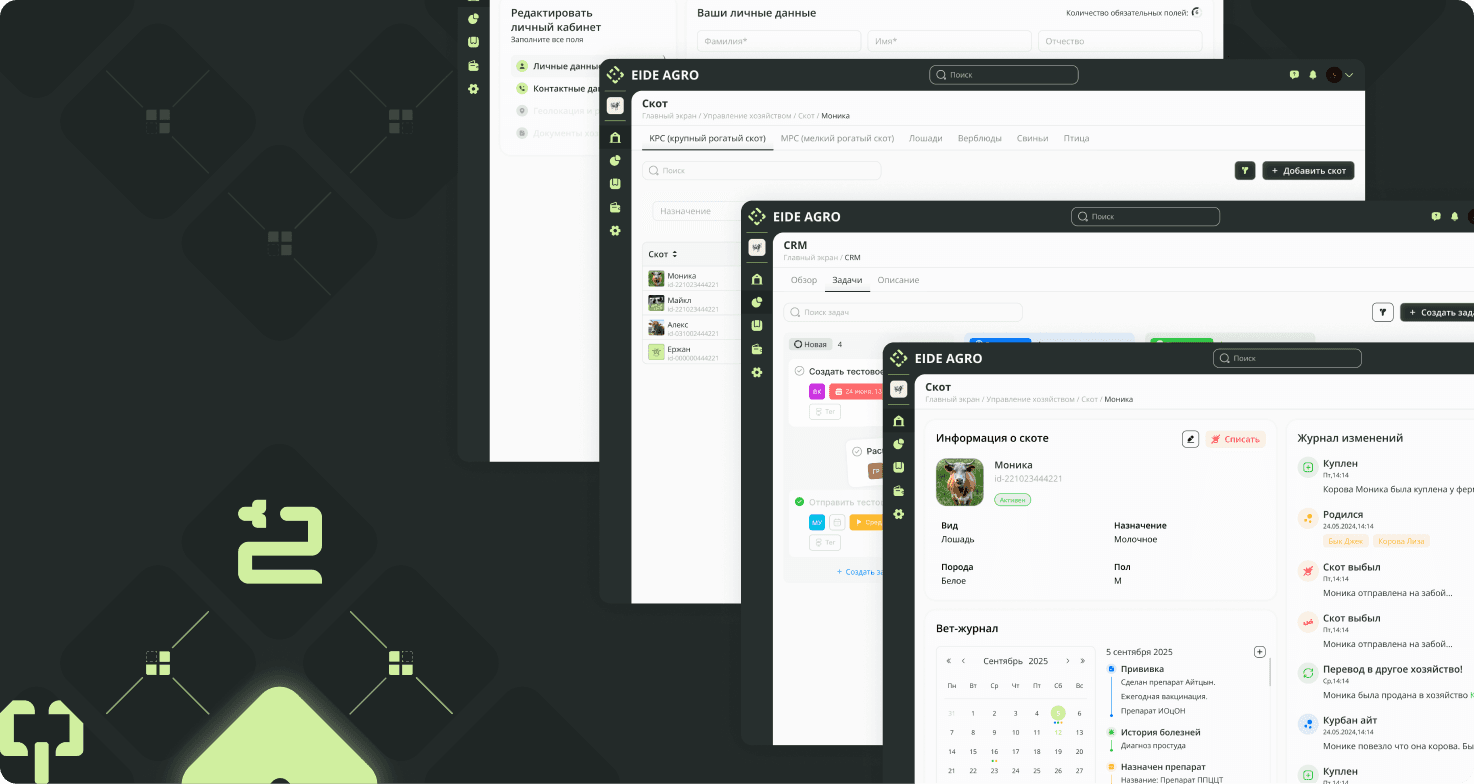
Interfaces
Results
1 SuperApp instead of 5+ services
Crops, livestock, machinery, warehouses and the marketplace on one platform.
0 → MVP
The product was designed from scratch: from hypotheses and the CJM to interfaces and a design system.
A deeply worked-out B2B core
The Livestock module is built around a farmer's real processes.
Scalable architecture
Built into the UX and IA: new modules are added without rebuilding navigation.
Design system
A single source of truth for consistency and faster development.